
Non Runner No Bet Explained: The Complete NRNB Guide for UK Horse Racing
18 min read · UK focus

Non runner no bet is, at its simplest, a promise: if your horse doesn't race, your money comes back. That three-word phrase — NRNB — sits at the heart of a quiet contract between bookmaker and punter, and in UK horse racing it has become one of the most important protections a bettor can have. Whether you're backing a fancied novice hurdler six weeks before the Cheltenham Festival or placing a same-day single at Kempton, understanding how NRNB works will shape the way you manage risk, select bookmakers, and ultimately decide where your money goes.
The stakes are not trivial. According to the Gambling Commission's Industry Statistics Annual Report for the financial year ending March 2025, gross gaming yield from remote horse racing betting in the UK reached £766.7 million — making it the second-largest sport for bookmakers after football. The appetite for racing bets is also sharply seasonal: participation in horse racing wagering jumped from 4% to 7% between January and July 2025, driven by the spring festivals that define the National Hunt calendar. When that many punters are active and that much money is in play, a single non-runner can ripple through thousands of bet slips in minutes.
This guide breaks down everything you need to know about NRNB in UK horse racing: what it means, how it interacts with Rule 4 deductions, where ante-post bettors are most exposed, which bookmakers offer the strongest protection in 2026, and how to build a strategy that keeps your stake protected no matter what happens between declarations and the off. Your stake, protected — that is the goal, and this is the roadmap.
The Short Version: NRNB Rules, Risks, and the Numbers That Matter
- Non Runner No Bet means your full stake is returned if your horse is withdrawn — but only on markets where NRNB applies. Standard ante-post bets settle as losers when a horse is scratched.
- UK horse racing GGY hit £766.7 million in 2024/25, yet turnover fell 16.5% over two years — bookmakers are using NRNB promotions to win ante-post volume back.
- Rule 4 deductions affect your payout when a different horse is withdrawn; NRNB voids your bet when your horse is withdrawn. They are not interchangeable.
- BHA rule changes in 2024 and 2025 expanded the definition of non-runner to include stalls refusals in both Flat and Jump racing — widening NRNB's practical scope.
- Always check whether your bookmaker refunds in cash or free bets, and stack NRNB with Best Odds Guaranteed for maximum protection on ante-post festival bets.
What Does Non Runner No Bet Mean in Horse Racing?
Non Runner No Bet (NRNB) means that if the horse you have backed is officially declared a non-runner before the race, your entire stake is returned — no deductions, no questions.
The concept is simple, yet the mechanics matter. Under standard rules, a horse withdrawn on race day triggers settlement under Tattersalls Rule 4(c): remaining runners have their prices adjusted, and your payout is reduced. With NRNB, the bet is voided entirely. The stake drops back into your account as cash — or, depending on the bookmaker, as a free bet.
It is worth drawing a line between two terms that get tangled in casual conversation. A non-runner is a horse that has been officially declared to run but is subsequently withdrawn before the off. A withdrawal, by contrast, usually refers to a horse taken out earlier in the process — at the five-day entry stage, the 48-hour declaration, or before final declarations. The distinction is not academic: NRNB typically covers non-runners on day-of-race markets, while ante-post withdrawals are almost never protected unless a bookmaker runs a specific promotional offer for that event.
A related abbreviation worth knowing is NRMB — Non-Runner Money Back — which functions identically to NRNB. Some bookmakers use one label, some use the other; the protection is the same.
Why does this matter beyond the individual bet slip? Because horse racing is a genuine economic engine in the UK. A House of Commons Library research briefing noted that the racing industry generates direct revenues exceeding £1.47 billion annually, contributes roughly £4.1 billion to the wider economy, and supports approximately 85,000 jobs. When betting turnover contracts — as it has for three consecutive years — the ripple effect reaches trainers, breeders, and racecourses. NRNB keeps casual punters engaged by removing the fear that a last-minute scratch will turn a researched selection into wasted money.
For seasoned bettors, NRNB is also a strategic filter. Restricting ante-post activity to bookmakers offering NRNB on festival specials lets you capture early prices without the full futures-market risk. In a sport where a single morning's news from Closutton or Seven Barrows can wipe out dozens of tickets, that filter is worth its weight in guineas.
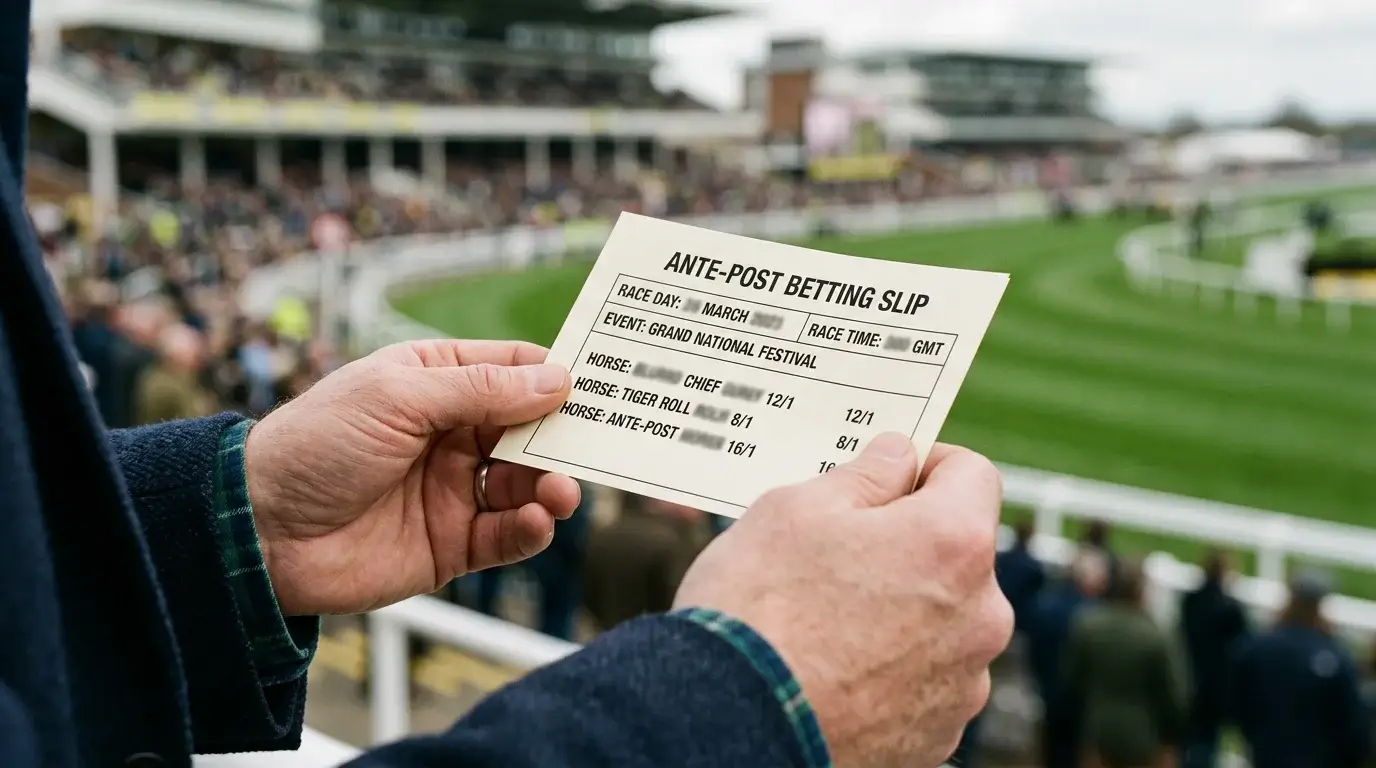
How Non Runner No Bet Works: Day-of-Race vs Ante-Post
The mechanics of NRNB depend entirely on when you place your bet and what type of market you are betting into. Those two variables — timing and market classification — determine whether you get your money back, lose the lot, or land somewhere uncomfortable in between.
Day-of-Race Markets
On day-of-race markets — sometimes labelled "day of race" or simply showing the current-day card — NRNB is usually applied automatically by most major UK bookmakers. You place a bet on a horse, the horse is declared a non-runner before the off, and your stake is refunded in full. No Rule 4 deduction is taken because the bet is treated as void, not as a settled wager on a reduced field. The process happens behind the scenes: your bet slip updates, the stake returns to your balance, and you can reinvest it immediately.
This is the version of NRNB that most punters know and take for granted. It is, in effect, the default consumer protection layer built into standard bookmaking practice for races where the full field is known.
Ante-Post Markets
Ante-post markets operate under different rules. When you back a horse weeks or months before the race — to capture a longer price before the market contracts — you are accepting a trade-off: better odds in exchange for carrying the risk that the horse might not run. Under standard ante-post terms, if your horse is withdrawn for any reason, your stake is lost. No refund, no Rule 4 deduction, no consolation. The bookmaker has priced the ante-post market to reflect that risk, and the odds you received were the compensation.
The exception is a bookmaker NRNB promotion. During major festivals — Cheltenham, Aintree, Royal Ascot, Glorious Goodwood — several bookmakers offer NRNB on selected ante-post markets. These promotions typically have conditions: they may apply only to specific races, only up to a certain stake, and only within a defined promotional window. Some refund in cash; others in free bets. Reading the terms is not optional.
How to Activate NRNB
In most cases, NRNB on day-of-race markets requires no action — it is applied automatically. For ante-post NRNB promotions, the process varies by bookmaker. Some require you to opt in before placing the bet. Others apply the offer automatically to any qualifying bet placed within the promotional period. A few need you to select a specific market tab labelled "NRNB" or "Non-Runner Money Back." Always check before you click confirm — assumptions cost money.
The statistical backdrop makes all of this more than theoretical. According to the BHA Racing Report for 2024, just 18,452 horses started at least one race in the UK that year — a 1% drop from the previous year's 18,630. The decline was concentrated in Jump racing, where the starter count fell 3%. The overall horse population in training has been shrinking at roughly 1.5% per year since 2022, per BHA's Q3 2025 report. Fewer horses in training means smaller fields, more scratches relative to declarations, and a higher practical relevance for NRNB in ante-post markets.
So NRNB protects you when a horse is scratched — but what happens to the rest of your bet slip when that horse disappears from the field? The answer involves three different mechanisms that are easy to confuse.
NRNB Compared: Standard Betting Rules, Rule 4, and Void Bets
Three terms get thrown around as if they are interchangeable, and they are not. NRNB, Rule 4, and void bets each describe a different outcome when a horse is withdrawn — and confusing them will cost you money or, at best, lead to an unpleasant surprise when you check your settled bets.
| Scenario | What happens to your bet | Stake returned? | Payout affected? |
|---|---|---|---|
| NRNB (your horse is a non-runner) | Bet voided entirely | Yes — full stake | N/A — no bet to settle |
| Rule 4 (another horse is a non-runner) | Bet stands, but payout reduced | No — bet is live | Yes — deduction from winnings |
| Void bet (race abandoned or technical void) | Bet cancelled by bookmaker | Yes — full stake | N/A — race didn't happen |
| Standard ante-post (horse withdrawn) | Bet loses | No | N/A — settled as a loser |
NRNB is not a void bet. A void bet occurs when the race itself is abandoned or the bookmaker cancels the market for regulatory or technical reasons. NRNB is a specific bookmaker commitment that applies when your selected horse is withdrawn — the race still goes ahead, and other bets on the same race are settled normally.
The confusion between NRNB and Rule 4 is even more common. If you have backed Horse A and Horse B is withdrawn from the same race, your bet on Horse A is not voided — it stands, but the payout may be reduced under Tattersalls Rule 4(c) to account for the absence of a competitor. The deduction depends on the price of the withdrawn horse: the shorter the price, the larger the deduction. NRNB only applies to your selection — the horse you actually bet on.
One more scenario worth flagging: if a horse is withdrawn and you hold a Rule 4-adjusted winning bet, but you also had a separate NRNB-eligible bet on the withdrawn horse, both outcomes apply independently. The winning bet gets the deduction; the NRNB bet gets refunded. They live on different bet slips and follow different rules.
Understanding these distinctions is foundational. Every section that follows — from ante-post risk to accumulator mechanics — depends on knowing which of these four outcomes you are facing.
Ante-Post Betting and NRNB: When Your Stake Is at Risk
Ante-post betting is where the biggest prices live — and where the biggest losses hide. Back a horse at 25/1 six weeks before a festival and you might be sitting on a goldmine; or you might be holding a worthless ticket because the horse picked up a tendon injury on Tuesday morning gallops. Under standard rules, that is your problem, not the bookmaker's.
The default position across every licensed UK bookmaker is clear: ante-post bets are settled as losers if the horse does not run. When you accept an ante-post price, the longer odds are your compensation for carrying the withdrawal risk. It is a fair exchange in theory — but it stings in practice.
The Henderson Cheltenham Crisis, 2024
Few cases illustrate the danger more starkly than what happened to Nicky Henderson's yard in the spring of 2024. Seven horses from Seven Barrows — including the brilliant Constitution Hill and the seasoned Shishkin — were withdrawn from the Cheltenham Festival due to illness. Ante-post backers who had taken early prices on those runners lost every penny. The estimated loss to Henderson alone in potential prize money was around £1.3 million, but the cumulative hit to punters who had backed his string ante-post was immeasurably larger. Anyone who had used a bookmaker offering NRNB on their Cheltenham ante-post market received a full refund. Everyone else absorbed the blow.

Grand National 2026: The Numbers Game
The Grand National is the most extreme example of ante-post non-runner risk in British racing. For the 2026 renewal, 78 horses were entered for just 34 starting places. That means a minimum of 56% of entries will not line up at Aintree — and when you factor in the typical race-week withdrawal rate of around 6%, the true non-runner proportion among entrants is closer to 60–65%. Backing a Grand National runner ante-post without NRNB protection is, statistically, a coin flip weighted against you before you even assess the horse's chance of winning.
The broader market trend reinforces the point. Total betting turnover on UK horse racing dropped 6.8% in 2024 compared to 2023, and was down 16.5% against 2022, according to the BHA Racing Report. Part of that decline reflects punters retreating from ante-post markets where they feel exposed — a rational response to repeated high-profile withdrawals.
Galopin des Champs and the 2026 Gold Cup
The pattern continued into 2026. Galopin des Champs — the dual Gold Cup winner in 2023 and 2024 — was withdrawn from the Gold Cup less than a week before the race. Constitution Hill, once again, was declared a non-runner. Trainer Willie Mullins confirmed the decision publicly: the horse had worked brilliantly on Thursday morning but felt below par on Friday, and the decision was made to skip the Gold Cup and other spring festivals entirely. For ante-post backers without NRNB, the news meant another dead ticket.
"After an excellent piece of work on Thursday morning, he was not feeling himself on Friday morning and will miss the Gold Cup and the other spring festivals" — Willie Mullins, Trainer, commenting on the withdrawal of Galopin des Champs ahead of the 2026 Cheltenham Festival.
If you bet ante-post without NRNB protection, you are accepting a risk that no amount of form study can mitigate. Injury, illness, and ground conditions are outside your control — and outside your bookmaker's obligation to cover, unless they have explicitly offered NRNB on that market.
Rule 4 Deductions: How Non-Runners Change Your Payout
When a horse is withdrawn from a race on the day, NRNB protects the punters who backed that specific horse. But what about everyone else? If you backed a different runner in the same race, your bet is still live — the race goes ahead — but the field has changed, and so has the implied probability of your horse winning. Tattersalls Rule 4(c) exists to rebalance the mathematics.
The Deduction Scale
Rule 4 deductions are applied to winnings (not your stake) and are based on the starting price of the withdrawn horse. The shorter the price, the bigger the impact on the remaining field, and the larger the deduction.
| SP of withdrawn horse | Deduction per £1 of winnings |
|---|---|
| 1/9 or shorter | 75p |
| Evens to 6/5 | 30p |
| 2/1 to 9/4 | 15p |
| 5/2 to 3/1 | 10p |
| Over 14/1 | No deduction |
The full scale includes intermediate steps — 70p for horses at 2/11 to 2/9, 50p for those at 4/9 to 8/15, and so on — but the pattern is consistent: the shorter the price of the withdrawn horse, the larger the slice taken from your winnings.
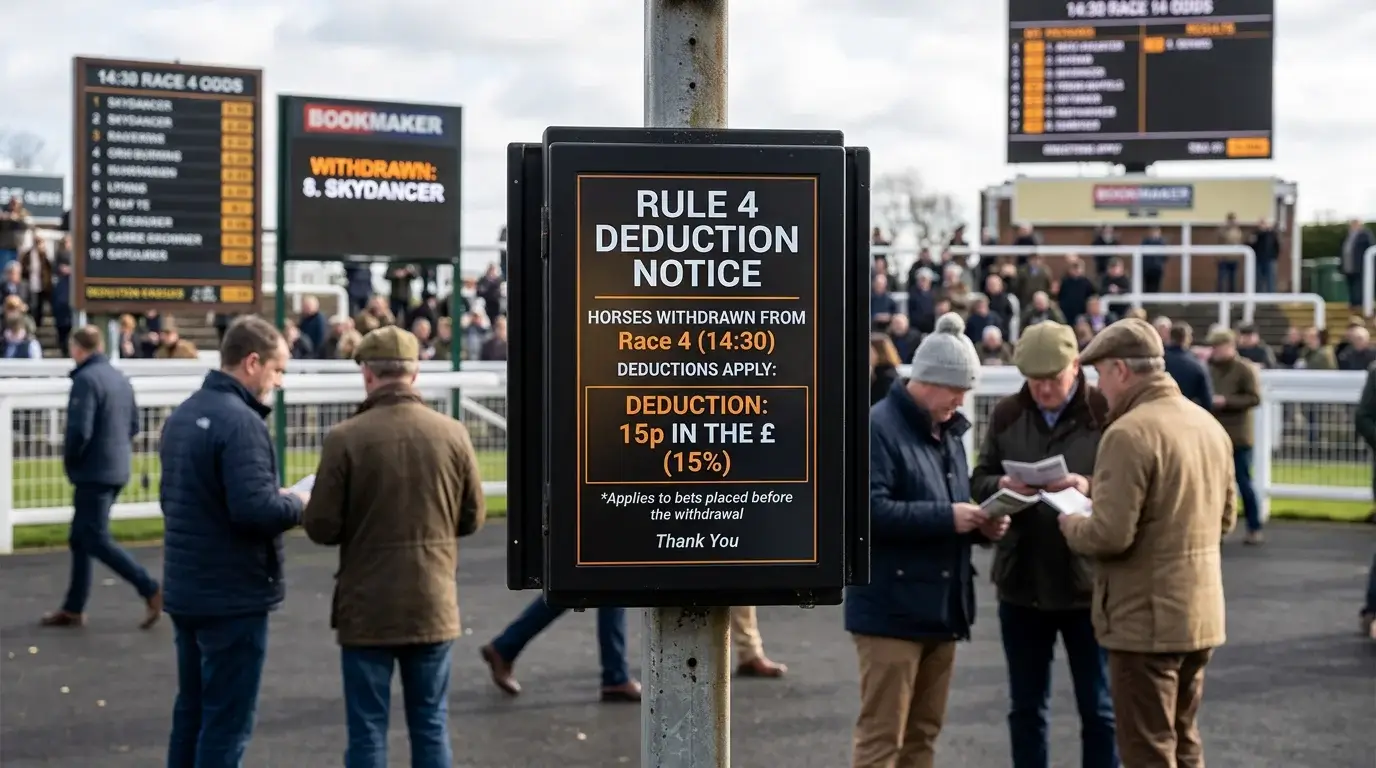
Worked example: Rule 4 on a winning bet
You place £10 on Horse A at 5.0 (4/1). Horse B, priced at 5/2, is withdrawn. The Rule 4 deduction is 10p in the pound.
Without Rule 4: £10 × 4 (profit portion) = £40 profit + £10 stake = £50 return.
With Rule 4: £40 profit × 0.90 = £36 profit + £10 stake = £46 return.
The £4 deduction accounts for the improved probability of Horse A winning after the removal of a credible competitor.
BHA Rule Changes: Expanding the Definition of Non-Runner
Until recently, a horse could only be declared a non-runner before it reached the starting stalls or tape. Two rule changes from the British Horseracing Authority have altered that landscape.
From 1 May 2024, stewards gained the power to declare a horse a non-runner in Flat races from the starting stalls if it was denied a fair start — for instance, if it reared up, became trapped, or refused to load. Previously, that horse would have been classified as "under starter's orders" and all bets would stand regardless of whether the animal had any realistic chance of competing. The change brought UK rules into alignment with the International Federation of Horseracing Authorities (IFHA) model rule.
"This amendment brings British racing in line with the IFHA model rule and provides greater clarity and consistency for all participants. It is expected to be used infrequently, but expanding the stewards' powers is a positive step" — Brant Dunshea, Chief Regulatory Officer, British Horseracing Authority.
Then, from 1 October 2025, the same principle was extended to Jump races run from a tape start. The BHA confirmed the expansion after the original stalls rule had been applied approximately half a dozen times since its introduction, and was well received across the sport.
For bettors, both changes mean that the pool of scenarios triggering NRNB (or Rule 4 for the remaining field) has widened. A horse that previously would have been classed as a starter can now be reclassified as a non-runner, with all the settlement implications that follow.
Rule 4 protects the market's integrity when the field shrinks. NRNB protects the individual punter whose selection is scratched. Both exist because non-runners are not rare — they are a structural feature of horse racing.
How Non-Runners Affect Different Bet Types
A non-runner does not affect every bet the same way. The outcome depends on the structure of the wager, and getting this wrong is one of the most common sources of frustration for punters who thought they understood the rules.
Singles
The simplest case. If you have a single bet on a horse that becomes a non-runner and the bookmaker offers NRNB on that market, your stake is refunded. If NRNB does not apply — for example, on a standard ante-post market — your bet is settled as a loser. On day-of-race markets where NRNB is the default, singles are the easiest bet type to manage: non-runner equals money back.
Accumulators and Multiples
Accumulators are where things get interesting. If one leg of your accumulator is a non-runner, that leg is removed from the bet entirely. The accumulator reverts to the next level down: a five-fold becomes a four-fold, a four-fold becomes a treble, and so on. Your bet is settled on the remaining legs at whatever odds they return. The key point: the non-runner leg is not treated as a winner — it is simply excised. Your potential payout shrinks because the multiplying effect of that leg disappears.
This is where punters feel shortchanged. You built a five-fold for the cumulative odds, and losing one leg to a non-runner removes that leverage without compensation. NRNB only applies to the specific leg — "applying" means removing it from the chain.
Each-Way Bets
An each-way bet is two bets in one: a win bet and a place bet on the same horse. If that horse becomes a non-runner, both parts are voided under NRNB. You receive a full refund of both stakes — the win portion and the place portion. If the non-runner is a different horse in the same race, Rule 4 deductions can apply to both the win and place components of your each-way bet, calculated separately. Additionally, if a non-runner reduces the field below a certain size, the place terms may change: a race offering 1/4 odds for three places might drop to two places, or each-way betting may be suspended entirely.
Lucky 15 and Lucky 31
These popular multiple-bet formats (15 bets across 4 selections, or 31 bets across 5) contain singles, doubles, trebles, and a four-fold or five-fold. A non-runner in a Lucky 15 collapses the structure: any bet that included the withdrawn horse has that leg removed, reducing the total number of active bets. A Lucky 15 with one non-runner effectively becomes a Lucky 7 (the seven bets from the remaining three selections). Your outlay remains the same — you paid for 15 bets — but the number of live bets drops. Some bookmakers offer consolation bonuses on Lucky 15s with one non-runner; check the terms.
Tote Pools
Tote bets follow different rules from fixed-odds bookmakers. In a Tote Placepot, if your horse is a non-runner, your selection is replaced by the favourite in that leg. You do not get a refund — you get a substitute. This can occasionally work in your favour if the favourite wins, but it strips away the value of your original selection. In Jackpot and Scoop6 pools, similar substitution rules apply, though the specific terms vary by pool type and Tote's current operating rules. If you are playing Tote pools and worried about non-runners, check the Tote's pool rules directly before placing your bet.
Edge Cases: Stalls Refusals, Exchanges, and Lay Bets
Most non-runner situations are straightforward: the horse is withdrawn, the bet is voided or deducted, and everyone moves on. But the sport produces enough ambiguity at the margins to catch even experienced bettors off guard. Here are the scenarios where the rules get complicated.
Stalls Refusals and the "Under Starter's Orders" Grey Zone
Before the BHA rule changes of 2024 and 2025, a horse that refused to load or became compromised in the stalls before the gates opened was deemed "under starter's orders" — and all bets stood, even if the horse never meaningfully competed.
The May 2024 rule change for Flat racing, and the October 2025 extension to Jump races, gave stewards the discretion to reclassify such horses as non-runners. As Shaun Parker, Head of Stewarding at the BHA, explained when the Jump rules came into effect: the stalls rule had been applied roughly half a dozen times since its introduction, it was well received, and there was appetite to see the same principle applied to tape-start races.
"The rule has been invoked about half a dozen times since its introduction for stalls races last year. It has been well received, and there was a desire to see this change extended to races from a tape" — Shaun Parker, Head of Stewarding, British Horseracing Authority.
The practical implication: if a horse is denied a fair start under either scenario, the stewards can now declare it a non-runner. Your NRNB-eligible bet on that horse would be refunded, and Rule 4 deductions would apply to the remaining field. If the stewards do not invoke the rule — perhaps because the horse did leave the stalls but stumbled immediately — the bet stands. The stewards' discretion is final.
Betfair Exchange: Reduction Factor, Not Rule 4
If you bet on the Betfair Exchange rather than a traditional bookmaker, non-runners are handled differently. The exchange does not use Tattersalls Rule 4. Instead, it applies a reduction factor (RF) — a percentage that adjusts the odds of all remaining runners based on the withdrawn horse's implied probability at the time of withdrawal.
The Betfair Exchange rules specify that if a horse's reduction factor is less than 2.5%, no adjustment is made at all — the withdrawal is deemed too insignificant to affect the market. For horses above that threshold, the formula is: (Decimal odds / 100) x RF = the amount by which your matched price is reduced.
Worked example: Betfair Reduction Factor
You backed a horse at decimal odds of 6.0. A rival horse is withdrawn with a reduction factor of 30%.
Adjustment: (6.0 / 100) x 30 = 1.8
New effective odds: 6.0 - 1.8 = 4.2
Your potential profit is reduced, but the bet is still live. If the horse wins, you are paid at the adjusted price.
The RF system is more granular than Rule 4: it adjusts dynamically based on actual market conditions rather than a fixed table. However, it can also produce surprising results — particularly in small fields where the removal of a short-priced horse shifts the entire market significantly.
Lay Bets and NRNB
NRNB does not apply to lay bets on the exchange. When you lay a horse, you are betting it will not win. If the horse is a non-runner, the lay bet is voided and your liability released — no NRNB promotion enters the equation.
Tote edge case: On the Tote, a non-runner in certain pool bets triggers substitution rules, not refunds. If you are used to fixed-odds NRNB, the Tote's approach can feel counterintuitive. In a Placepot, for instance, your non-runner selection is automatically replaced by the SP favourite. You retain your stake, but your bet is now riding on a horse you never chose.
Which Bookmakers Offer Non Runner No Bet in 2026?
NRNB availability varies more than you might expect. Every major UK bookmaker applies NRNB automatically on day-of-race markets — that is effectively an industry standard. The differences emerge on ante-post markets, where NRNB is a promotional offer, not a default setting. In 2026, with betting turnover down 16.5% over two years and the average handle per race continuing to slide, bookmakers have been increasingly willing to use NRNB promotions as a competitive tool to attract ante-post activity back to their platforms.
The table below summarises the typical NRNB positions of the major operators. Note that promotional terms change frequently — especially around festivals — and you should always verify current offers directly with the bookmaker before placing your bet.
| Bookmaker | NRNB Day-of-Race | NRNB Ante-Post | Refund Type | Festival Specials | BOG Included |
|---|---|---|---|---|---|
| bet365 | Yes (auto) | Selected festivals | Cash | Cheltenham, Aintree, Royal Ascot | Yes |
| Paddy Power | Yes (auto) | Selected festivals | Cash / Free bet (varies) | Cheltenham, Grand National | Yes |
| William Hill | Yes (auto) | Selected festivals | Free bet | Cheltenham, Aintree | Yes |
| Sky Bet | Yes (auto) | Limited | Free bet | Cheltenham | Yes |
| Ladbrokes | Yes (auto) | Selected festivals | Free bet | Cheltenham, Aintree, Royal Ascot | Yes |
| Betfair Sportsbook | Yes (auto) | Selected festivals | Cash | Cheltenham, Grand National | Yes |
| Coral | Yes (auto) | Selected festivals | Free bet | Cheltenham, Aintree | Yes |
| BoyleSports | Yes (auto) | Selected festivals | Free bet | Cheltenham | Yes |
A few distinctions are worth drawing out. The difference between a cash refund and a free bet refund matters more than it appears at first glance. A cash refund returns your stake to your withdrawable balance — it is real money. A free bet refund gives you a bet token of equal value, but you cannot withdraw it; you must use it on another bet, and typically only the profit from that second bet is withdrawable. Over time, a bookmaker that consistently refunds in cash rather than free bets is offering materially better value.
The festival coverage also varies. bet365 and Ladbrokes have historically been the broadest, extending NRNB to ante-post markets on Cheltenham, Aintree, and Royal Ascot. Paddy Power and Betfair Sportsbook tend to focus on the National Hunt festivals. Sky Bet and BoyleSports have narrower coverage, often limited to specific feature races rather than full festival cards.
One useful context point: the BHA's Q3 2025 data showed non-runner rates at their lowest since 2022, and the authority has begun publishing withdrawal data by individual trainer. This transparency gives bettors more information to assess the likelihood of a non-runner in any given race — but it also gives bookmakers more data to price their NRNB promotions more precisely. The market, in other words, is getting smarter on both sides.
Knowing which bookmaker offers what is useful context. But the most instructive way to understand NRNB's value is to look at what happens when it is absent — and in UK racing history, there are several cases that made the lesson painfully clear.
Notable Non-Runner Cases in UK Racing History
The rules around non-runners were not written in theory — they were forged by specific incidents that exposed gaps in the system. These cases shaped how bookmakers, regulators, and punters think about withdrawal risk today.
Speculative Bid — Royal Ascot, 2015
Speculative Bid became one of the most debated non-runner cases in recent memory when the horse was withdrawn from the Queen Mary Stakes at Royal Ascot after loading into the starting stalls. The filly broke through the front gates of the stall before the race started, was caught, and was then deemed unfit to race. The critical question was whether the horse had been "under starter's orders" at the point of withdrawal. If so, all bets stood. If not, bets were void. The ruling that the horse was a non-runner triggered both NRNB refunds for backers and Rule 4 deductions for the rest of the field. The case directly influenced the BHA's 2024 review of stalls procedures.
Henderson's Cheltenham Catastrophe, 2024
The mass withdrawal of seven Nicky Henderson horses from the 2024 Cheltenham Festival remains the most significant cluster non-runner event in modern festival history. Constitution Hill, the reigning Champion Hurdle winner, was the headline withdrawal, but the removal of six other runners from one of the most followed yards in National Hunt racing sent shockwaves through ante-post markets. Bettors who had built accumulators around Henderson's runners saw their bets systematically dismantled. Those without NRNB cover lost their stakes entirely on the affected legs.
Galopin des Champs — Gold Cup, 2026
The dual Gold Cup winner's withdrawal from the 2026 renewal — confirmed less than a week before race day — was the highest-profile single non-runner of the current season. Constitution Hill, too, was declared absent yet again, extending a frustrating pattern for ante-post backers who had repeatedly been caught on the wrong side of that horse's availability. The case underscored a simple truth: past performance does not guarantee future participation, and the most fancied horses often carry the highest non-runner risk because their connections can afford to be patient.
Constitution Hill has been declared a non-runner at the Cheltenham Festival in three of the last four seasons. For ante-post bettors, he has arguably cost more money through withdrawals than he has won for them on the track.
What These Cases Teach
Each of these cases reinforced the same lesson in different ways: non-runner risk is not an edge case — it is a central feature of horse racing, particularly at the festival level. The sport's structure — with multiple entry stages, long build-ups, and horses trained to peak at specific targets — creates an environment where last-minute withdrawals are not anomalies but recurring events. NRNB exists because the sport demands it.
How to Use NRNB Strategically for Ante-Post Value
NRNB is not just a safety net — it is a strategic edge. Used deliberately, it allows you to capture ante-post value while controlling the one risk that form study cannot address. Here is how to build it into your betting process.
Strategy 1: Filter Bookmakers by NRNB Before You Price-Shop
Most punters start by checking odds across bookmakers and placing with whoever offers the best price. Flip the order. Start by identifying which bookmakers are running NRNB on the market you want. Then compare prices only among those operators. The best price at a non-NRNB bookmaker is not actually the best price if there is a 30% chance the horse does not run — a 10/1 shot with NRNB can be worth more than a 12/1 without it.
Strategy 2: Monitor the 48-Hour Declaration Window
The 48-hour declaration stage is where the final field begins to take shape. Trainers must confirm their runners, and many ante-post withdrawals cluster around this point. By timing your bets to land just after the 48-hour declaration — when the field is more settled but NRNB ante-post offers may still be live — you reduce non-runner risk while still capturing prices that have not yet compressed to day-of-race levels. This window is narrow, typically a few hours, but it is where informed bettors operate.
Strategy 3: Stack NRNB with Best Odds Guaranteed
Best Odds Guaranteed (BOG) ensures that if the starting price drifts above the price you took, you are paid at the higher odds. Combined with NRNB, this creates a two-layer protection: your stake is safe if the horse does not run, and your price is protected if the market moves against you after you bet. Most of the leading UK bookmakers offer both on the same bet. It is free insurance — use it.

The Market Context for Strategic Betting
These strategies do not exist in a vacuum. The UK horse racing betting market is going through a structural shift that makes NRNB more important than it was even three years ago.
The return from betting turnover to the racing industry in the UK sits at roughly 0.6–0.7% — a figure that looks stark when placed alongside international comparators. In Ireland the equivalent is 1.5%, in France 8.6%, in the United States 14.5%, and in Japan 16.6%, according to analysis by Thoroughbred Daily News. The UK model relies overwhelmingly on the levy — the statutory payment from bookmakers to racing — and that levy hit a record £109 million in 2024/25 according to the HBLB Annual Report. The March 2025 Cheltenham Festival contributed significantly to that total, with results that ran in the bookmakers' favour.
Yet the paradox is telling: the levy hit record levels while betting turnover declined. The average handle per race fell 8% year-on-year, and was down 19% compared to the 2021/22 season. As Grainne Hurst, CEO of the Betting and Gaming Council, noted in response to the figures: record levy payments show regulated bookmakers' commitment to racing, but falling turnover is a concern — especially when unlicensed operators contribute nothing.
"Levy payments have risen to record levels for the fourth straight year, showing the long-term commitment of regulated bookmakers to racing. However, it is concerning that turnover has again fallen. Unlicensed operators pay no tax and do not contribute a penny to the levy" — Grainne Hurst, CEO, Betting and Gaming Council.
The practical takeaway: bookmakers are under pressure to retain horse racing customers, and NRNB promotions are a direct response. They cost money when horses withdraw, but they bring ante-post volume that would otherwise disappear. As a punter, you benefit — but only if you actively seek out the offers.
Pre-Bet Checklist: Before You Back Ante-Post
- Does the bookmaker offer NRNB on this specific market?
- Is the refund in cash or a free bet?
- Does BOG also apply to this bet?
- Have the 48-hour declarations been made?
- What is the trainer's recent non-runner rate at this festival?
- Would an exchange lay hedge be more cost-effective than relying on NRNB alone?
Frequently Asked Questions About Non Runner No Bet
Do I get my money back if my horse is a non-runner in an accumulator?
Not exactly — the non-runner leg is removed from the accumulator, and your bet is recalculated on the remaining legs. A five-fold becomes a four-fold, a four-fold becomes a treble, and so on. You do not lose your entire stake, but you lose the multiplying effect of that leg. If all remaining legs win, you are paid at the reduced accumulator odds. If the non-runner was your only remaining leg, your full stake is returned.
Is NRNB the same as a void bet?
No. NRNB applies when your selected horse is declared a non-runner — the race still goes ahead, other bets settle normally, and only your bet on the withdrawn horse is voided. A void bet occurs when the entire race is abandoned or the market is cancelled for regulatory or technical reasons. The practical effect (stake returned) is similar, but the triggers are different, and understanding which applies prevents misplaced expectations.
Can I get NRNB on ante-post bets for the Grand National?
Yes, but only through specific bookmaker promotions — it is not a standard rule. Several major UK bookmakers, including bet365, Paddy Power, and Ladbrokes, typically run NRNB offers on Grand National ante-post markets in the weeks leading up to the race. However, these promotions have conditions: they may apply only within a certain date range, up to a maximum stake, and refunds may be issued as free bets rather than cash. Given that the Grand National regularly sees more than 50% of entries fail to make the final field, seeking out an NRNB offer before backing a horse ante-post is particularly important for this race.
NRNB Glossary: Key Terms for UK Horse Racing Bettors
NRNB (Non Runner No Bet) — a bookmaker offer or market condition under which your stake is refunded in full if your selected horse is declared a non-runner before the race.
NRMB (Non-Runner Money Back) — an alternative label for NRNB used by some bookmakers. The protection is identical: stake returned if the horse does not run.
SP (Starting Price) — the official odds of a horse at the moment the race begins, as determined by on-course bookmakers. SP is the reference point for Rule 4 deductions and for Best Odds Guaranteed comparisons.
BOG (Best Odds Guaranteed) — a bookmaker promise that if the starting price exceeds the price you took when placing your bet, you will be paid at the higher odds. Often available alongside NRNB on day-of-race markets.
Rule 4 (Tattersalls Rule 4(c)) — a deduction applied to winnings when a horse is withdrawn from a race after the final declarations. The deduction scale is based on the starting price of the withdrawn horse and compensates for the reduced field.
Ante-Post — a bet placed before the day of the race, typically weeks or months in advance. Ante-post bets offer longer odds but carry the risk that withdrawals are not covered unless the bookmaker offers a specific NRNB promotion.
Reduction Factor (RF) — the Betfair Exchange equivalent of Rule 4. A percentage-based adjustment applied to matched odds when a horse is withdrawn. If the RF is below 2.5%, no adjustment is made.
Void Bet — a bet that is cancelled and the stake returned, typically because the race was abandoned or the market was invalidated. Distinct from NRNB, which voids only your specific bet on a withdrawn horse while the race continues.
Each-Way — a bet consisting of two equal parts: one on the horse to win and one on the horse to finish in a specified number of places. If the horse is a non-runner under NRNB, both parts are refunded.
Accumulator — a single bet combining multiple selections across different races. All selections must win for the bet to pay out at full combined odds. If one leg is a non-runner, that leg is removed and the accumulator is recalculated on the remaining selections.